
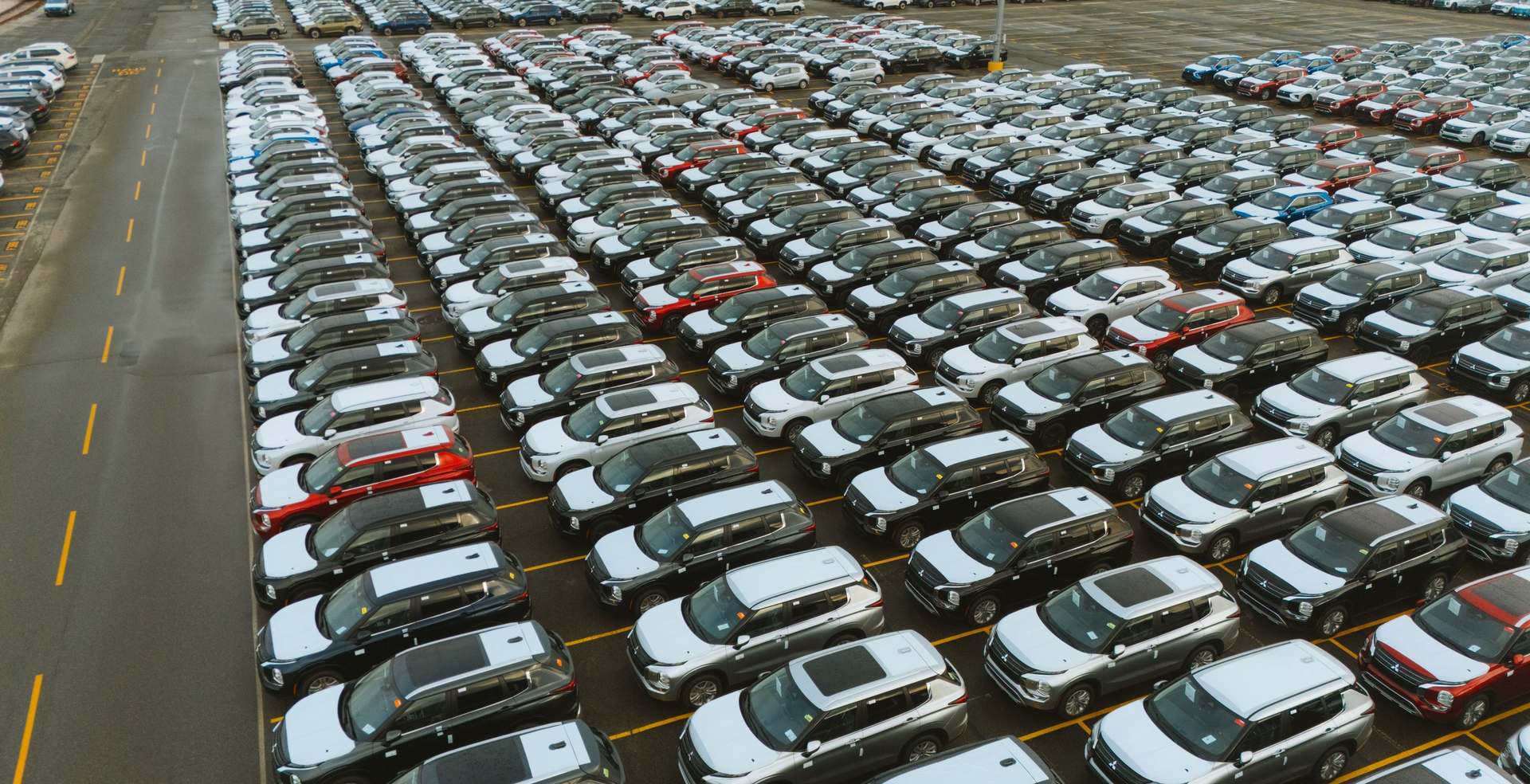
Suanshu Haiyuan · Built for China's vehicle exports
Automotive export management systems
China's vehicle exports run on this software: procurement, documents, shipping, clearance, overseas warehousing, showroom delivery and aftersales, with cost and profit reconciled per vehicle by VIN. Sixteen product lines, all implemented. Six demo tenants open without registration.
Prefer Chinese? The Chinese edition of this page carries the full source list and every numeric caveat. 本页中文版
- Product lines16, all implemented
- Business groups5
- Region packsCore pack + 16 country packs
- Master dataOne VIN file, one cost card
- Public demo6 tenants, no registration
1. What this is — and what it is not
A system that opens orders. Not a consulting deliverable.
Vehicle export is usually described as one business. In practice it is a sequence of hand-offs: someone decides what to buy, someone prepares the vehicle, someone assembles the documents, someone books the vessel, someone clears it, someone sells it in the destination market, and someone finally reconciles what the deal earned. Cost, documents and stock change hands at every step — and that is where spreadsheets appear.
Suanshu Haiyuan is built along that sequence. What you receive is a tenant with accounts: modules switched on, base data and rules configured (VIN rules, cost subjects, document templates, country packs), interfaces and data migration, and support through go-live. Not a report, not customs brokerage, not freight forwarding, not trade finance, not a loan.
Because the boundary matters as much as the scope: financial ledgers stay in your existing finance system and are reconciled through the open API, so nothing forces a second set of books. A product line is an operating surface for one part of the chain, not a separate product with its own master data — adding the second line does not mean migrating the first.
What an automotive export management system covers
Definition, nine stages, naming variants, four business types, eight selection tests, non-scope and how a quotation is structured.
Read the category page (中文)How a quotation is split
Six itemised lines — software product, implementation and configuration, data migration, custom development, systems integration, ongoing service. No fixed price list.
See the pricing modelIf the question is what a China automotive export management system is supposed to contain, the Chinese category page carries the full definition: the nine stages, the naming variants buyers use (management system / software / ERP / DMS / SaaS), the eight selection tests and the explicit non-scope. It is in Chinese and marked as such.
2. Five business situations, five systems
Most buyers recognise themselves in one row. The rest become expansion.
| Business situation | System | What it covers |
|---|---|---|
| New-vehicle export to overseas dealers and 4S networks | Haiyuan·Car — Vehicle Export Management System (DMS) | Group procurement, booking and loading, destination clearance, duty allocated by VIN, PDI, overseas warehouse, showroom delivery, aftersales |
| Used-vehicle export | Haiyuan·Hand — Used-Vehicle Export Management System | Buy-in and appraisal, reconditioning, pre-export inspection, export licence, customs documents, shipment, collection and export tax refund |
| Vehicle trade operations, domestic wholesale and retail plus export | Haiyuan·Trade — Vehicle Trade Operations System | Purchase orders and arrival plans, VIN file, stock and in-transit kept apart, wholesale and retail delivery, export allocation, invoice and refund ledger |
| Overseas warehouse and delivery | Haiyuan·Warehouse and Haiyuan·PDI | Booked and in transit, destination clearance, bonded stock, four-segment pre-delivery check, defect loop, handover documents |
| Overseas 4S retail and aftersales | Haiyuan·Dealer and Haiyuan·Service | Showroom retail, finance and registration at destination, handover, repair orders, parts supply, warranty claims and CSI |
Parts and accessories export trade (Haiyuan·Parts) is the sixth system and the sixth demo tenant. It belongs to the same product line as overseas aftersales parts, not to a seventeenth line.
The two mainlines are new-vehicle export and used-vehicle export. They are also the two tenants most buyers should open first, because they show the two shapes of the problem: one vehicle many documents (new), and one file per vehicle with a licence per batch (used).
3. Sixteen product lines in five groups
One suite, not sixteen products. Each group covers one stretch of the chain.
| Group | Product lines | The question the group answers |
|---|---|---|
| Trade and sourcing | Vehicle export dealership · Used-vehicle export · Store operations · Sourcing and procurement · Trade operations | What to buy, at what landed cost, and on which terms it is sold |
| Logistics and delivery | Cross-border logistics and in-transit · Overseas warehouse and bonded stock · PDI and delivery centre | Where the vehicle is, what it is waiting for, and when it can move |
| Compliance and finance | Export compliance and documents · Export finance and settlement | Whether the document set is complete, and what the deal actually earned |
| Channel and retail | Overseas 4S and showroom retail · Brand website and lead acquisition · Connected vehicle and fleet | How the overseas entity sells, stocks and prices |
| Aftersales and service | Aftersales and warranty claims · Parts and accessories supply chain · EV powertrain and charging service | What happens after handover: repair, warranty, parts and connected data |
All sixteen lines are implemented. Two open a public demo tenant; the rest are demonstrated per role and target market.
Vehicle export management system (DMS)
The nine-stage mainline from group procurement to aftersales CSI, with duty allocated per VIN.
Open the product lineUsed-vehicle export management system
One file per vehicle, one licence per batch, a document gate before shipment, collection and tax refund.
Open the product lineAll sixteen lines, in one place
Group by group, with the shared foundation and what the brand deliberately does not publish.
See the full list4. One vehicle, one record, one cost card
The point of a suite is that the second line does not begin with a data migration.
One file per vehicle for its whole life: configuration code, build month, colour, mileage, ownership and status history. The same vehicle is the same record in the yard, on the vessel, in the overseas warehouse and in the retail order.
Vehicle, procurement, logistics, landed duty in the destination country, reconditioning and storage, and collection. Rebates sit in their own line instead of being netted into the vehicle price, so the quotation, the gross-margin report and the collection reversal read the same numbers.
Purchase and buy-in → export licence and customs → transport and insurance → destination clearance → collection and refund. A missing item is reported before the vehicle leaves, not when it is stuck at the port.
Seventeen packs — one core plus sixteen countries — mounted per destination market. Market differences (taxes, documents, certification, language, currency) arrive as configuration; the business code does not change.
What sits on top is deliberately boring, because it is what makes the suite usable: role-based permissions with data scopes, an audit trail on every state change, and five surfaces sharing one source — internal workbench, dealer portal, mobile, group dashboard and brand website.
5. A new market is a pack, not a project
The main process is one. The market differences are configuration.
Procurement, shipment, clearance, landed duty, delivery and aftersales are the same six moves everywhere, so they are built once. What changes between markets is the part that changes fastest: tax treatment, the document set, certification, language and currency. Those are held in country packs, split along three axes — regulation, policy and taxation.
Opening a market therefore means mounting a pack and confirming its parameters, not rewriting a process. Where a market has no pack yet, the pack is configured for that destination; the surrounding system does not move.
- Core pack plus sixteen country packs: Philippines, Vietnam, Thailand, Indonesia, Malaysia, Brazil, Mexico, Chile, Peru, United Arab Emirates, Saudi Arabia, Turkey, Kazakhstan, Uzbekistan, South Africa, Nigeria.
- Each pack carries its own tax and duty parameters, document templates, certification requirements, language and currency conventions.
- Three currencies are carried in one account: CNY, USD and BRL, with the exchange rate written at posting so a rate change never silently rewrites an old margin.
6. How a rollout starts
One mainline first. The rest loads onto a base that already works.
- Pick the mainline that hurts most: usually new-vehicle export or used-vehicle export, not the whole suite.
- Load the data that decides money first — VIN rules, cost subjects, document templates, the opening stock — so the first quotation is already computed the way you intend to keep computing it.
- Connect what you already run: finance, ERP, logistics or the carrier, through the open API. Nothing forces a second ledger.
- Run one real shipment end to end, from purchase order to collection, with the people who will actually use it.
- Add the next product line only when the hand-off between the first two is clean. New lines attach to the same master data; they do not re-implement it.
Delivery is remote by default: deployment, data initialisation and training, with on-site time reserved for opening a market or a critical milestone. We quote a schedule per phase after seeing your chain, and we do not publish fixed go-live numbers on this site.
7. Six public demo tenants, no registration
Open one and click. Sample vehicles, sample customers, nothing to fill in.
Haiyuan·Car
New-vehicle export dealership: procurement, shipment, clearance, PDI, overseas warehouse, showroom delivery and aftersales.
Open the tenantHaiyuan·Hand
Used-vehicle export: buy-in, reconditioning, inspection, export licence, documents, shipment, collection and refund.
Open the tenantHaiyuan·Parts
Parts and accessories export trade: catalogue matching, quotation snapshots, documents, tax refund and margin attribution.
Open the tenantHaiyuan·Trade
Vehicle trade operations: purchase orders, VIN file, stock and in-transit, wholesale and retail delivery, export documents, books.
Open the tenantHaiyuan·Shop
Domestic used-car store: lead to buy-in, reconditioning, stock, retail and trade sale, delivery promise and per-vehicle cost.
Open the tenantCommercial-vehicle 4S platform
A second 4S tenant built on the same foundation, for commercial vehicles rather than passenger cars.
Open the tenantTwo things to know before you click. The tenant interface is in Simplified Chinese — the data model and the screens are the product, and the language is a display layer. And every value in the demo is constructed: no real registration numbers, prices or customers.
The English demo and cases page explains the half-hour route by role, so the visit produces a decision rather than a slideshow.
8. Questions buyers ask first
Short answers. The detailed ones are on the linked pages.
Is this an ERP?
It covers the business side — procurement, stock, export documents, landed cost, delivery, aftersales. General financial ledgers stay in the customer's existing finance system and reconcile through the open API, so the suite does not ask you to keep two sets of books.
Do we have to take all sixteen product lines?
No. Lines attach to the same master data, so you can start with one mainline and add later without a migration. Most customers start with new-vehicle export or used-vehicle export and add logistics, compliance or aftersales once the first hand-off is clean.
Does it work outside China?
The main process is the same everywhere; market differences arrive as country packs. Seventeen packs ship today, one core plus sixteen countries across Southeast Asia, Latin America, the Middle East, Central Asia and Africa. A market without a pack is configured as one.
How long does implementation take?
It depends on how much of the chain you load and how clean your master data is. We scope one mainline first and quote a schedule per phase after reviewing your process. This site does not publish fixed go-live numbers, because a number quoted before seeing the chain is a guess.
Is the demo a real system or a slideshow?
A real tenant on a real deployment, opened per role from the login page. You can create orders, generate documents and break things; the data is sample data, and nothing you do affects a customer.
What does it cost?
A project quotation split into six itemised lines: software product, implementation and configuration, data migration, custom development, systems integration and ongoing service. There is no published price list — the split is on the pricing page, the amounts are not.
Scope of this page
Suanshu Haiyuan. What the suite covers, and where the numbers come from. Shanghai Siyang Information Technology Co., Ltd.. https://eficien.com/en/ (English edition 2026-11-26). Product-line counts, the region-pack count and the demo-tenant count match the Chinese edition of this site; this page gives no customer names, deployment counts, performance figures or prices.
This page describes what the systems carry. It is not legal, tax or customs advice. Rates, categories, deadlines and document requirements follow the competent authority's current rules and must be confirmed by your responsible staff and professional advisers.
Tell us the chain, and we will tell you which line to start with
Thirty minutes on your roles, your markets and the one hand-off that costs the most today.
Book a 30-minute walkthrough